If you’ve ever stood in a school gymnasium, an airport terminal, or a stadium and heard an announcement come through crisp and clear, you’ve experienced a well-engineered public address (PA) system at work. But behind every speaker, amplifier, and microphone is something far less glamorous , and far more important , than the equipment itself: the cable.
Choosing the wrong cable type for a PA system doesn’t just cause weak sound. It can cause hum, signal loss, overheating, fire risk, and total system failure over long distances. So which type of cable is used in a public address system? The honest answer is: several and which one you need depends on where it sits in the signal chain.
This guide breaks down every cable type used in a PA system, when to use it, and how to choose the right gauge and shielding for your setup.
1. Overview: The PA System Signal Chain
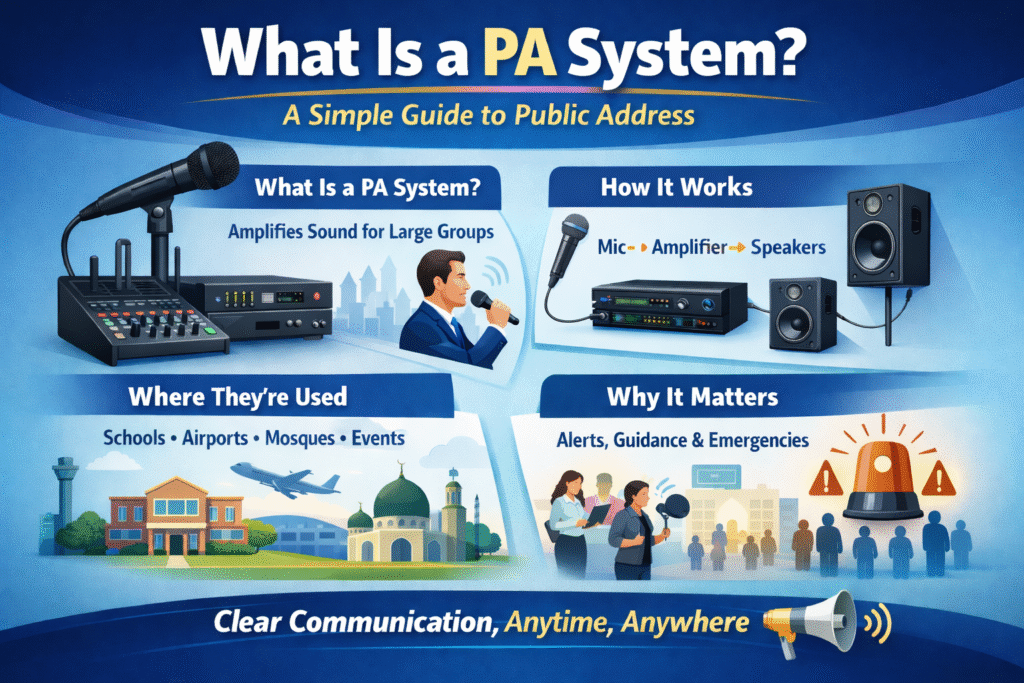
Before picking a cable, it helps to understand where cabling fits in a typical PA system:
Microphone / Source → Mixer/Preamp → Amplifier → Speaker Cable → Speakers
Each stage carries a different type of signal (mic-level, line-level, or speaker-level), and each signal type needs a different cable.
2. Microphone Cable (XLR Cable)
Best for: Connecting microphones to mixers or amplifiers.
Microphone cable almost always terminated with XLR connectors — is a balanced, shielded, twisted-pair cable. This is arguably the most recognizable cable type in any public address system.
Key features:
- Balanced design (two conductors + shield) cancels out electrical interference
- Shielding prevents hum from lighting rigs, HVAC systems, and power cables
- Flexible for handheld and podium mic use
- Standard gauge: 24–26 AWG conductors
Why it matters: Mic-level signal is extremely weak (measured in millivolts), which makes it highly vulnerable to electromagnetic interference. Using unshielded cable here is one of the most common causes of buzz and hum in PA systems.
3. Line-Level Cable (Balanced TRS / XLR)
Best for: Connecting mixers, preamps, and signal processors to amplifiers.
Once the mic signal is boosted to line level, it typically travels through balanced TRS (Tip-Ring-Sleeve) or XLR cable. Like mic cable, it’s shielded and twisted-pair, but engineered for line-level voltage rather than mic-level.
When unbalanced (RCA/TS) cable is used instead: Shorter runs, consumer-grade equipment, or budget installs sometimes use unbalanced cable but this is not recommended for professional PA systems or runs over 15–20 feet, since it’s far more prone to noise.
4. Speaker Cable , The Core of PA Wiring
Best for: Carrying amplified signal from the amplifier to the speakers.
This is the cable most people mean when they ask “which type of cable is used in a public address system.” Speaker cable is fundamentally different from mic or line cable:
- Unbalanced, two-conductor (positive and negative)
- No internal shielding required (amplified signal is strong enough to resist interference)
- Copper, stranded conductors, sized by AWG (American Wire Gauge)
Common speaker cable gauges for PA systems
Cable Length | Recommended Gauge |
Under 50 ft | 16 AWG |
50–100 ft | 14 AWG |
100–200 ft | 12 AWG |
200+ ft | 10 AWG |
Rule of thumb: The longer the cable run or the lower the speaker impedance, the thicker (lower-numbered) the gauge needs to be to prevent power loss and overheating.
5. 70V / 100V Constant-Voltage Cable (Commercial PA Systems)
Best for: Large-scale, multi-zone PA systems , schools, offices, warehouses, retail, transit hubs.
Most commercial and institutional PA systems don’t wire speakers the way home audio systems do. Instead, they use a constant-voltage (70V or 100V) distributed audio system, which allows dozens (or hundreds) of speakers to run off a single amplifier over long distances.
Why 70V/100V cable is different:
- Higher voltage, lower current means thinner gauge cable can run much farther without signal loss
- Typically 16–18 AWG two-conductor cable is sufficient even for runs of several hundred feet
- Each speaker has a built-in transformer to step voltage back down
This is the industry-standard answer for anyone asking about wiring school PA systems, office paging systems, or stadium announcement systems — 70V/100V constant-voltage cable is almost always the backbone.
6. Plenum-Rated & Outdoor Cable
Best for: Ceiling installs, HVAC air spaces, and outdoor/weatherproof PA runs.
Cable type isn’t only about signal it’s also about safety and durability:
- Plenum-rated cable (CMP) is required by fire code in most commercial buildings when cable runs through air-handling spaces (drop ceilings, HVAC ducts). It uses fire-retardant, low-smoke insulation.
- Outdoor/direct burial cable uses UV-resistant, moisture-sealed jacketing (often polyethylene) for stadiums, parking lots, and campus-wide paging systems.
Using standard indoor-rated (CM) cable outdoors or in plenum spaces is both a code violation and a fire hazard; this is a detail many DIY installers overlook.
7. Cable Type Comparison Table
Cable Type | Signal Carried | Shielded? | Typical Connector | Common Use in PA Systems |
XLR Mic Cable | Mic-level | Yes | XLR | Microphones to mixer |
Balanced Line Cable | Line-level | Yes | XLR / TRS | Mixer to amplifier |
Standard Speaker Cable | Speaker-level | No | Bare wire / Speakon | Amp to speakers (short/medium runs) |
70V/100V Cable | Constant-voltage | No | Bare wire / terminal block | Multi-zone commercial PA |
Plenum-Rated Cable | Any (rated jacket) | Varies | Varies | In-ceiling / HVAC spaces |
Outdoor/Direct Burial + Cable | Speaker or constant-voltage | Varies | Weatherproof connectors | Stadiums, campuses, parking lots |
8. How to Choose the Right Cable for Your PA System
Ask these four questions before buying cable:
- What signal stage is this cable for? Mic-level, line-level, or speaker-level signals each need a different cable type.
- How long is the run? Longer runs need thicker gauge (or a constant-voltage system) to avoid power loss.
- Where is it installed? Indoor drop ceilings need plenum-rated cable; outdoor runs need weatherproof or direct-burial cable.
- How many speakers are on the line? Multi-zone commercial installs almost always call for a 70V/100V constant-voltage design rather than standard low-impedance speaker cable.
Final Thoughts
There’s no single “right” cable for a public address system , the correct choice depends entirely on where that cable sits in the signal chain. Microphones need shielded, balanced XLR cable to stay quiet. Amplifiers need the right gauge of speaker cable to deliver power without loss. And large, multi-zone installs almost always call for 70V/100V constant-voltage cable to keep dozens of speakers running cleanly off one amp.
If you’re specking a new system, start by mapping out your signal chain and cable run lengths first , the cable choice follows naturally once you know what each segment actually needs to carry.