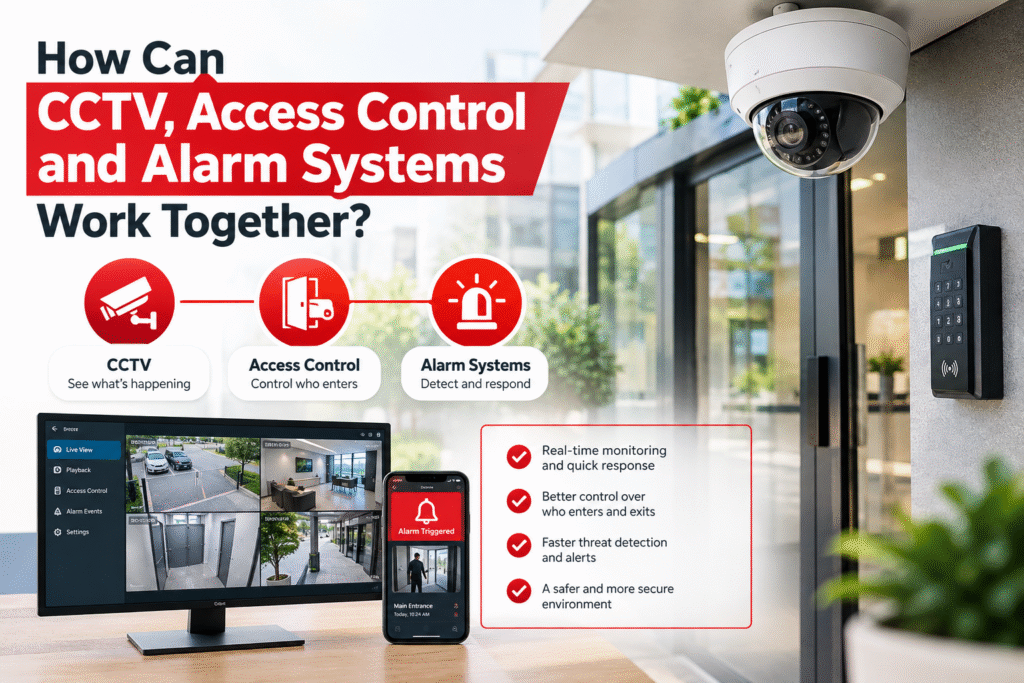
Modern security threats don’t wait for one system to catch up before the next reacts. That’s why businesses and homeowners are moving away from standalone security tools and toward integrated security systems where CCTV cameras, access control, and alarm systems all communicate in real time.
In this guide, we’ll break down exactly how these three technologies work together, why integration matters more than ever, and how to choose the right integrated security solution for your property.
What Is Security System Integration?
Security system integration means connecting your video surveillance system, access control system, and intrusion alarm system through a single management platform. Instead of three separate tools operating in silos, integration allows them to share data and trigger automatic responses.
For example: if an alarm is triggered, your CCTV cameras can automatically pull up the relevant camera feed, while your access control system locks down doors near the breach — all within shuman intervention.
How Each System Works on Its Own
Before diving into integration, it helps to understand each component individually.
CCTV (Closed-Circuit Television) Systems
CCTV cameras provide visual verification recording and monitoring activity across a property. Modern IP camera systems and video management software (VMS) support remote viewing, motion detection, and AI-based analytics like facial recognition and license plate recognition.
Access Control Systems
Access control systems manage who can enter specific doors, floors, or zones using key cards, fobs, mobile credentials, PIN codes, or biometric access control (fingerprint or facial recognition). They create a digital audit trail of entries and exits.
Alarm Systems
Intrusion alarm systems detect unauthorized entry, glass breaks, or motion in restricted areas, alerting a monitoring center or the property owner instantly.
Individually, each system solves a piece of the security puzzle. Together, they close the gaps.
How CCTV, Access Control, and Alarm Systems Work Together
1. Real-Time Video Verification of Alarm Events
When an alarm is triggered, the integrated system automatically pulls footage from the nearest camera. Instead of a monitoring center reacting to a beep with no context, they get live or recorded video verification, dramatically reducing false alarm dispatches a major cost driver for businesses using traditional alarm monitoring.
2. Access Events Trigger Camera Recording
Every badge swipe, door open, or failed access attempt can automatically trigger nearby cameras to record and tag that footage. This creates a searchable link between who accessed a door and what actually happened on camera critical for investigations and compliance audits.
3. Automatic Lockdown During a Security Breach
If an alarm is triggered say, a forced door or a break-in — the access control system can automatically lock down specific zones or the entire building, while CCTV focuses on the affected area. This is especially valuable for schools, hospitals, and corporate offices needing rapid lockdown protocols.
4. Centralized Monitoring Through One Dashboard
Instead of switching between three different software platforms, an integrated system gives security teams a single unified command center to view camera feeds, manage door access, and respond to alarms improving response time and reducing human error.
5. Smarter Alerts Through AI and Analytics
Combined systems can use AI-driven video analytics alongside access logs to flag unusual patterns like someone badging in but not appearing on camera (a sign of tailgating or credential sharing), or repeated failed access attempts followed by alarm activity.
Key Benefits of Integrating CCTV, Access Control, and Alarms
- Faster incident response — automated triggers mean less time between detection and action
- Reduced false alarms — video verification confirms real threats before dispatch
- Stronger audit trails — synced video and access logs simplify investigations and compliance
- Lower long-term costs — one platform to manage instead of three separate vendors/systems
- Remote management — monitor and control your entire security ecosystem from a mobile app or web dashboard
- Scalability — easily add cameras, doors, or sensors as your property or business grows
Who Benefits Most From Integrated Security Systems?
- Commercial offices — managing employee access and after-hours monitoring
- Retail stores — reducing theft and verifying incidents for insurance claims
- Warehouses & logistics — controlling high-traffic loading areas
- Schools & universities — enabling rapid lockdown response
- Healthcare facilities — restricting access to sensitive areas while maintaining compliance
- Residential properties & gated communities — combining smart locks, doorbell cameras, and alarm monitoring
How to Choose the Right Integrated Security System
When evaluating providers or building a system, look for:
- Open platform compatibility — can your CCTV, access control, and alarm hardware integrate, or are you locked into one manufacturer?
- Cloud vs. on-premise management — cloud-based systems typically offer easier remote access and updates.
- Scalability — can the system grow with additional cameras, doors, or locations?
- AI and analytics support — does it support smart alerts, not just recording?
- Professional monitoring options — 24/7 monitored response vs. self-monitored alerts.
- Installation and support — local vendor support matters for troubleshooting and maintenance.
Frequently Asked Questions
Can CCTV and access control use the same software?
Yes. Most modern security platforms offer unified software (VMS + access control software) that manages both cameras and door access from one interface.
Do I need an alarm system if I already have CCTV and access control?
Yes — cameras and access control are largely reactive/preventive, while alarms actively detect intrusions in real time. Together they cover detection, prevention, and verification.
Is integrating these systems expensive?
Costs vary by property size and existing infrastructure, but many providers offer scalable, cloud-based options that reduce the need for expensive on-site servers.
Can I integrate my existing security equipment, or do I need to replace it?
It depends on your current hardware. Many modern platforms support integration with existing IP cameras, access control panels, and alarm systems — a security consultant can assess compatibility.
Final Thoughts
CCTV, access control, and alarm systems are no longer meant to operate independently. When integrated, they form a proactive, intelligent security ecosystem that detects threats faster, verifies incidents accurately, and responds automatically protecting your people, property, and assets more effectively than any standalone system could.
If you’re ready to upgrade to an integrated security solution, Contact SEFA for a free security assessment tailored to your property.