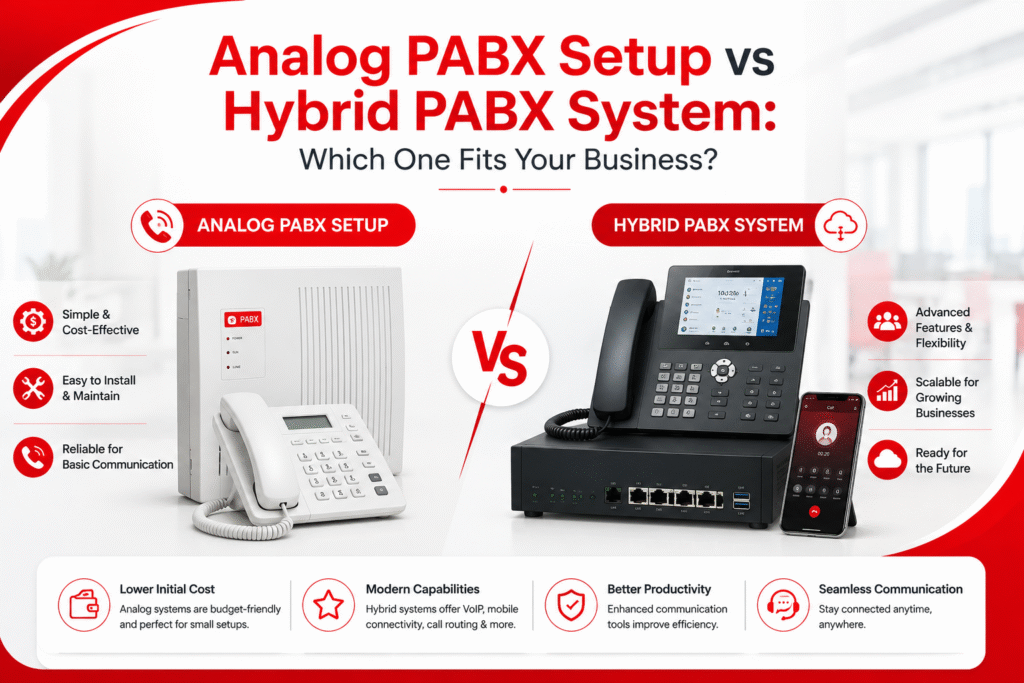
Choosing the right telephone infrastructure is one of the most important decisions a growing business makes. Two of the most commonly compared options are an Analog PABX setup and a Hybrid PABX system. While both are built around the same core idea — a Private Automatic Branch Exchange that connects internal extensions and manages external calls — they differ significantly in technology, flexibility, cost, and scalability.
In this guide, we break down what each system is, how they work, and the key differences between an Analog PABX setup and a Hybrid PABX system, so you can choose the right telecom solution for your office.
What Is an Analog PABX Setup?
An Analog PABX setup is a traditional telephone exchange system that uses analog signals to transmit voice calls over copper wiring. It connects internal extensions to each other and to the Public Switched Telephone Network (PSTN) using analog phone lines.
Key Features of an Analog PABX Setup
- Supports both analog and VoIP (IP) lines simultaneously
- Compatible with existing analog handsets and new IP phones
- Enables remote and mobile extensions over the internet
- Advanced features: call recording, voicemail-to-email, auto attendant, CRM integration
- Scalable as business communication needs grow
- Reduces long-term calling costs via VoIP trunks
Hybrid PABX systems are a popular choice for medium to large businesses looking for a smooth transition from legacy analog infrastructure to modern IP telephony — without discarding existing equipment.
What Is a Hybrid PABX System?
A Hybrid PABX system combines both analog and digital (IP/VoIP) technologies in a single platform. It allows businesses to continue using existing analog phone lines and handsets while also enabling IP-based extensions, internet calling, and advanced call management features.
Key Features of a Hybrid PABX System
- Supports both analog and VoIP (IP) lines simultaneously
- Compatible with existing analog handsets and new IP phones
- Enables remote and mobile extensions over the internet
- Advanced features: call recording, voicemail-to-email, auto attendant, CRM integration
- Scalable as business communication needs grow
- Reduces long-term calling costs via VoIP trunks
Analog PABX Setup vs Hybrid PABX System: Key Differences
| Feature | Analog PABX Setup | Hybrid PABX System |
|---|---|---|
| Technology Used | Analog signals only | Analog + Digital/IP (VoIP) |
| Call Type Support | Voice calls over copper lines | Voice, VoIP, and internet-based calls |
| Hardware Compatibility | Analog handsets only | Analog handsets + IP phones/softphones |
| Scalability | Limited; hard to expand | Highly scalable with modular expansion |
| Remote Working Support | Not supported | Supported via IP extensions |
| Initial Cost | Lower | Moderate to higher |
| Long-Term Cost | Higher (traditional line charges) | Lower (VoIP reduces call costs) |
| Advanced Features | Minimal (basic call transfer, hold) | Auto attendant, IVR, call recording, CRM integration |
| Best Suited For | Small offices, budget setups | Growing businesses, multi-branch offices |
| Future-Readiness | Limited upgrade path | Easily upgradable to full IP-PBX |
Analog PABX Setup: Pros
- Simple and quick installation
- Lower initial investment
- Reliable for basic voice communication
- No dependency on internet connectivity
- Easy for staff to learn with minimal training
- Works well even during internet outages
- Low maintenance requirements
- Well-suited for small teams with straightforward calling needs
Hybrid PABX System: Pros
- Combines the best of analog and digital telephony
- Supports remote and multi-branch operations
- Cost savings through VoIP trunking
- Rich feature set for customer service and productivity
- Protects existing investment in analog handsets and wiring
- Flexible growth path — add IP extensions as the business expands
- Improves customer experience with auto attendant and call routing
- Enables centralized management across multiple office locations
Which One Should You Choose?
- Choose an Analog PABX setup if you run a small office with a limited number of extensions, a tight budget, and no immediate need for remote work or advanced call features.
- Choose a Hybrid PABX system if your business is scaling, has multiple branches, needs remote/mobile extensions, or wants to gradually migrate to VoIP without replacing existing analog equipment.
Conclusion
Both Analog PABX setups and Hybrid PABX systems have their place in modern business communication. An Analog PABX setup offers simplicity and low cost for small-scale needs, while a Hybrid PABX system delivers flexibility, scalability, and future-readiness by blending analog reliability with digital innovation.
If you’re planning to upgrade your office communication system or are unsure which setup suits your business size and budget, evaluating your current call volume, growth plans, and remote work requirements will help you make the right choice between an Analog PABX setup and a Hybrid PABX system..9