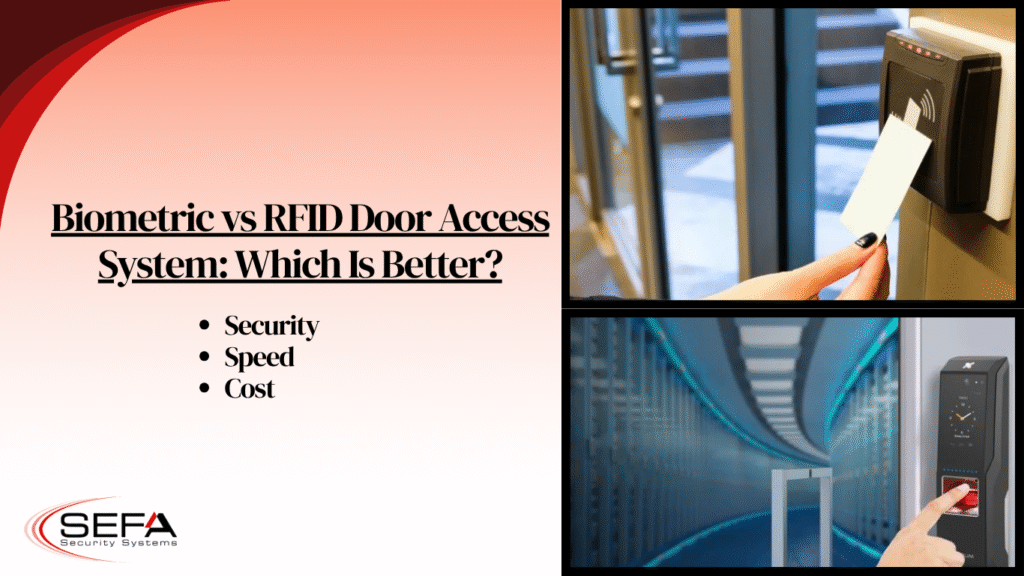
If you’re upgrading door access security for your office, warehouse, or residential building in Dubai, chances are you’ve landed on the same question every property owner eventually asks: should you go with a biometric door access system or stick with RFID cards? Both are everywhere across the UAE, from bank branches to gated communities, and both do the same basic job controlling who gets through the door. But the way they do it, and how well each one fits your situation, is where the real differences show up.
In this guide, we’ll break down how each technology actually works, where they shine, where they fall short, and how to decide which one makes sense for your property. No sales pitch, just a straightforward comparison to help you make the right call
Biometric vs RFID Door Access System: How Each One Works
At the core, every access control system is solving the same problem: how do you verify that the person at the door is actually allowed in? RFID and biometric systems just answer that question differently.
RFID (Radio Frequency Identification) relies on something you carry a card, fob, or tag. Tap it near a reader, and a radio signal confirms your identity to the system, which then unlocks the door if your credentials check out.
Biometric access control relies on something like your fingerprint, face, or iris. There’s no card to carry or forget; the system simply scans and matches your unique physical traits against what’s already stored on file.That one distinction “what you carry” versus “who you are” shapes almost everything else in this comparison.
Speed and Convenience: Biometric vs RFID Door Access System
For high-traffic entry points, speed matters more than people realize. RFID cards are essentially instant a quick tap and you’re through, which makes them a natural fit for busy offices, hotels, and residential lobbies where dozens of people move through the door every hour.
Biometric readers are fast too, usually authenticating in one to three seconds, but they can slow down slightly in real-world conditions, think sweaty fingers, poor lighting for facial recognition, or someone standing at an awkward angle. That said, the upside is you never have to dig through your bag looking for a misplaced card.
Which Door Access System Keeps Intruders Out?
This is usually the deciding factor for most businesses. RFID cards, while convenient, come with an inherent weakness: they can be lost, borrowed, or in the case of older low-frequency cards, cloned with cheap equipment available online. A stolen card doesn’t know it’s stolen; it’ll open the door for anyone holding it.
Biometric credentials solve that problem at the root. You can’t lend out your fingerprint, and modern systems include liveness detection to block spoofing attempts using photos or fake prints. For facilities handling sensitive data, cash, or restricted areas, think server rooms, banking floors, or high-value storage biometric access control simply offers a stronger layer of protection.Pairing your access control with a CCTV system takes it a step further, giving you a visual record of every entry alongside the access logs, so you always know who came through and when.
Cost of a Biometric vs RFID Door Access System
Budget is often the first question business owners ask, and it’s a fair one. RFID systems typically have a lower upfront cost; the readers and cards themselves are inexpensive, and installation is quicker in most standard setups. The catch is ongoing expense: lost or damaged cards need replacing, and every new employee means issuing another credential.
Biometric systems ask for a bigger investment upfront, since the hardware (fingerprint or facial recognition scanners) costs more to install. But once it’s running, there’s no card management, no replacement costs, and adding new users is often as simple as enrolling their biometric data into the existing system.
Scaling Your Door Access Control System as You Grow
If you’re planning to expand more staff, more entry points, more buildings both systems can scale, just differently. RFID setups grow easily by issuing more cards, though very large installations may eventually need upgraded readers or antennas. Biometric systems tend to integrate cleanly into existing IT infrastructure, which makes centralized management simpler across multiple sites, though the specialized hardware at each new access point adds to setup time.
Biometric vs RFID Door Access System
|
factors |
RFID |
Biometric |
|
cost |
lower |
higher |
|
Security level |
Moderate |
high |
|
speed |
instant |
1-3 sec |
|
Best for |
High traffic , general access |
Sensitive or security zone |
|
hygiene |
contactless |
Touchless option |
Which Door Access System Should You Choose?
It depends on what you’re protecting. For general offices, retail spaces, or residential buildings where convenience and cost matter most, RFID usually does the job well, especially with encrypted, high-frequency cards that are harder to clone. For facilities that handle sensitive data, valuable assets, or restricted areas, biometric access control is worth the extra investment for the added peace of mind.
Many businesses in Dubai don’t pick just one; they go with a hybrid setup, using RFID for smooth day-to-day access and layering biometric verification on sensitive zones like server rooms, executive floors, or storage areas. This “Card + Fingerprint” or “Card + Face” combination is becoming increasingly common across UAE offices, and it gives you the best of both worlds: speed where you need it, and airtight security where it matters most.
Installing the Right Door Access Control System
Whichever system you lean toward, one thing holds true: even the best access control technology is only as reliable as its installation. A poorly configured system, weak cabling, or a reader placed in the wrong spot can undo all the security benefits on paper.
At SEFA, we’ve been designing and installing SIRA-approved door access control systems across Dubai since 2003, working with banks, retail brands, and residential communities to find the right balance of security, convenience, and budget. Even if you need a straightforward RFID setup, a full biometric solution, or a hybrid system tailored to your property, our team handles the site survey, installation, and integration with your existing CCTV or IT infrastructure from start to finish.For villas and smart buildings, we also fold access control into a broader home automation setup, so your doors, cameras, and lighting all work together from a single app.
Final Thoughts
There’s no universal winner between biometric and RFID door access systems, only the option that fits your risk level, budget, and daily foot traffic. Take stock of what you’re actually protecting, how many people need access, and how much convenience matters versus airtight security. And if you’re still unsure, a quick site assessment from a qualified access control provider can settle the debate faster than any comparison chart.