Every missed call can mean a missed customer, but what if your business phone system could automatically route, manage, and optimize every single conversation without chaos or confusion?
In today’s fast-moving business environment, communication systems are no longer just about making and receiving calls, they are about efficiency, scalability, and customer experience. That’s where PABX and PBX systems come in. While both are designed to manage internal and external business communication, many decision-makers still struggle to understand the real difference between them and which one best fits modern business needs.
In this guide, we break down what a PABX system is, how it works, and the key differences between PBX and PABX so you can make a smarter, future-ready communication choice for your business.
What Is a PABX System?
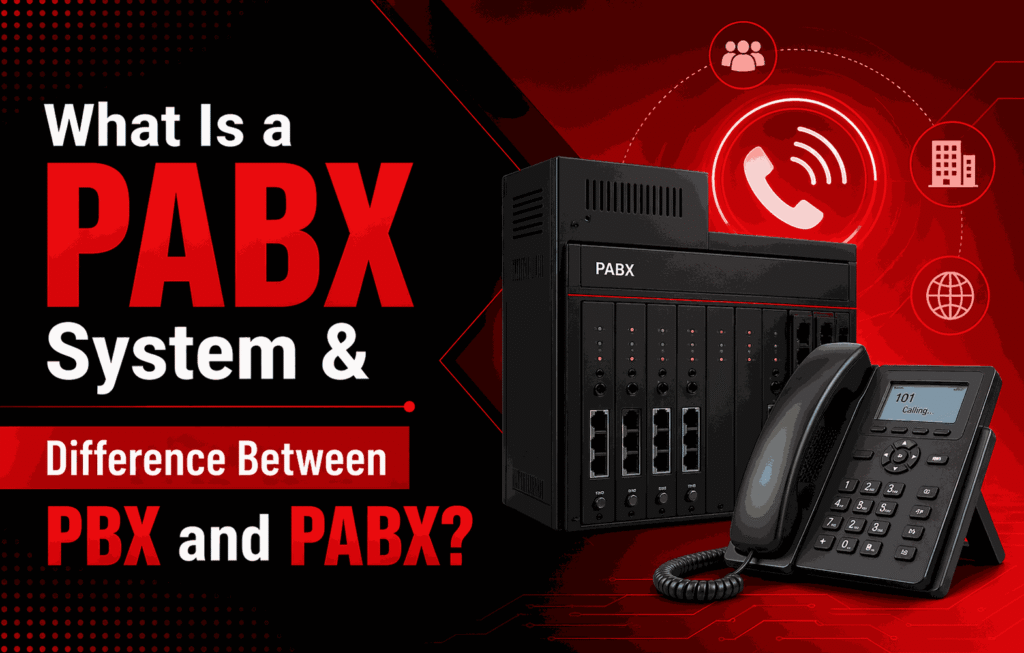
PABX stands for Private Automatic Branch Exchange.
A PABX system is a private telephone network used within a company that streamlines communication between employees and customers while reducing the need for multiple direct phone lines. Instead of assigning a separate line to each user, it connects all office phones through a single, centralized network, making call management more efficient and cost-effective. With one main business number, the system intelligently routes incoming calls to the correct department or individual, ensuring a smooth, professional, and organized communication experience for both staff and clients.
So when someone calls your business, they can:
- Press 1 for sales.
- Press 2 for support.
- Or dial an extension to reach the right person instantly.
How Does a PABX System Work?
A PABX system efficiently manages incoming and outgoing calls through a centralized control unit.
Basic Process:
When a customer calls your business number, the system automatically receives the call, routes it to the correct extension, and connects it to the right employee for quick and efficient communication. This is exactly how a professionally designed PABX system installation Dubai helps businesses streamline call handling and improve responsiveness. It ensures no calls are missed, reduces waiting time for customers, and keeps communication organized across departments. As a result, companies can deliver a smoother, more professional, and highly responsive calling experience while improving overall customer satisfaction through reliable PABX services.
Key Components:
- Central control unit – The core system that manages and processes all calls.
- Extensions – Internal phone lines that connect employees within the network.
- Trunks – External lines that link your system to the public telephone network.
- Switching system – Intelligently routes calls to the correct destination.
Key Features & Benefits of a PABX System
A PABX system combines advanced communication features with strong business benefits, helping companies improve efficiency, reduce costs, and deliver a more professional customer experience.
- Call Routing – Automatically directs incoming calls to the right person or department, improving response time and customer satisfaction while reducing missed calls.
- IVR (Interactive Voice Response) – Allows callers to navigate menu options using voice or keypad, ensuring faster access to the required service and reducing workload on staff
- Call Transfer – Enables smooth transfer of active calls between employees or departments, improving internal collaboration and workflow efficiency.
- Voicemail – Records and stores messages when calls are not answered, ensuring no important inquiry is lost and improving customer service continuity
- Call Recording – Helps monitor and review conversations for training, compliance, and quality improvement, supporting better business performance.
- Auto Attendant – Provides a professional automated greeting that enhances brand image and guides callers efficiently to the right department
- Conference Calling – Supports multiple participants in a single call, making team meetings and client discussions more flexible and productive.
What Is a PBX System?
PBX stands for Private Branch Exchange
A traditional telephone system is used by businesses to manage both internal and external communication. It connects multiple office phones through a central system, allowing employees to communicate within the organization and handle incoming and outgoing business calls efficiently, making it a foundational business phone system UAE solution for many companies.
Key Point:
A PBX system typically relies on manual operation or basic switching to connect and manage calls within the business network.
Difference Between PBX and PABX
PBX and PABX are both telephone systems used in businesses, but they differ mainly in automation, efficiency, and technology. PBX is an older system that often requires manual or semi-automatic operation, while PABX is a modern, fully automated solution designed for faster and smarter call management.
| Aspect | PBX (Private Branch Exchange) | PABX (Private Automatic Branch Exchange) |
|---|---|---|
| Full Form | Private Branch Exchange | Private Automatic Branch Exchange |
| Operation | Manual or semi-automatic | Fully automatic |
| Call Handling | Requires operator assistance | No operator needed |
| Automation | Limited | Advanced automated routing |
| Efficiency | Slower communication process | Faster and more efficient |
| Cost | Higher long-term maintenance | More cost-effective and scalable |
| Features | Basic call functions | IVR, voicemail, call routing, and more |
| User Experience | Complex and traditional | Simple, modern, and professional |
Key Differences Explained
PBX systems depend on manual or operator-assisted call handling, which makes them slower and less efficient by modern business standards. In contrast, PABX systems are fully automated and intelligently route calls to the correct person or department without any human intervention. From a usability perspective, PBX is more traditional, complex, and outdated, while PABX is designed to be simple, user-friendly, and highly efficient. On the technology side, PBX represents an older communication setup, whereas PABX is a more advanced, scalable, and automation-driven solution. This is why modern businesses prefer PABX systems for faster communication, improved professionalism, and enhanced customer service.
Types of PABX Systems
PABX systems are available in different types, each designed to meet specific business communication needs, from traditional office setups to modern cloud-based solutions.
Traditional (Analog) PABX
Operates using physical telephone lines and is suitable for small businesses with basic communication requirements, making it a simple and cost-effective option for limited communication needs.
IP PABX
Works through internet protocol (VoIP), offering greater flexibility, better scalability, and improved communication features
Hosted PABX (Cloud-Based)
A fully cloud-managed solution that requires no physical hardware, is maintained by a service provider, and is ideal for remote teams and growing businesses.
Which One Should You Choose?
If you are starting a new business or upgrading your existing communication system, a PABX system is the better choice as it offers modern, automated, and efficient call management that supports business growth and professionalism. This is why many companies prefer IP PABX systems in Dubai to ensure reliable and future-ready communication infrastructure.
You should choose PABX if you want automation, professional call handling, reduced communication costs, and a system that can easily scale as your business grows. On the other hand, PBX should be avoided if you require modern features, flexible scalability, and simple, easy-to-manage communication solutions designed for today’s fast-paced business environment.
Future of Business Communication & Real-World Use Cases
PABX systems are evolving rapidly with AI and cloud integration, making communication smarter and more efficient. Modern features like intelligent call routing, voice recognition, CRM integration, and real-time analytics help improve customer service and decision-making. This shift is driving strong demand for PABX system installation, as businesses upgrade to advanced solutions for better efficiency and performance.
In practical use, PABX systems are widely adopted across different industries. Small businesses use them to handle customer calls efficiently without the need for extra staff, while call centers manage high call volumes through automated routing. Corporate offices benefit from improved internal communication via extensions, and remote teams stay connected easily using cloud-based PABX solutions from anywhere.
In the UAE market, SEFA is recognized among trusted providers offering advanced PABX solutions tailored for modern business needs. Such providers focus on delivering reliable, scalable, and efficient communication systems that support business growth and ensure smooth day-to-day operations.
Common Mistakes to Avoid
- Choosing outdated PBX systems that lack modern features, flexibility, and automation needed for today’s business communication.
- Ignoring scalability and selecting a system that cannot grow with your business requirements over time.
- Not adopting cloud-based PABX solutions, which offer better cost savings, remote access, and flexibility.
- Overlooking essential features like IVR, call routing, and voicemail, which improve customer experience and efficiency.
- Focusing only on initial cost instead of long-term value, performance, and system reliability.
Conclusion
A PABX system is an essential tool for modern business communication that streamlines call management, improves efficiency, and enhances customer experience. While PBX systems are outdated and rely on manual processes, PABX systems, especially cloud-based ones, offer better performance, flexibility, and cost savings. In simple terms, PBX is traditional and manual, whereas PABX is modern and automated. For businesses that want professional communication and smooth operations, investing in a PABX system is the smarter choice.